AI-Powered Anomaly Detection for Wind Energy Operations
Designing a transparent, evidence-backed anomaly detection system that gave field engineers a reason to trust automated alerts, turning silent turbine failures into a workflow they could verify and act on with confidence.
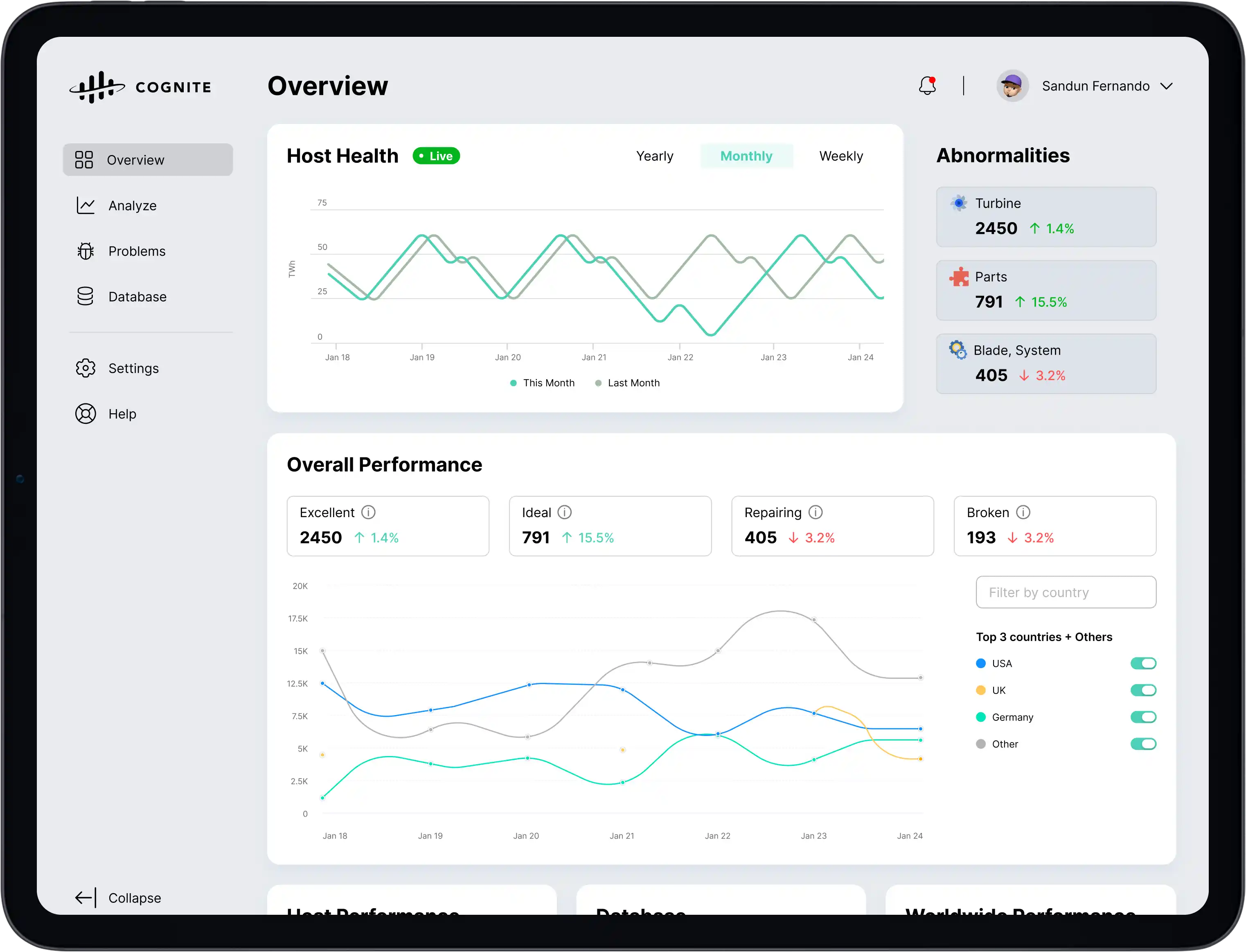
↑ The global operations dashboard: real-time visibility into every turbine's health, from a single screen.
The silent failure problem
Standard monitoring in wind energy operations is built to catch the obvious. It misses the subtle anomalies that actually predict a failure. A classic example engineers described to me was "sudden low turbine speed" during otherwise "steady wind conditions", a pattern that looks unremarkable on its own but signals real trouble underneath.
The reason was structural. Threshold-based alarms only trigger once a value crosses an extreme limit, and by then it's often too late. What engineers actually needed was a system that understood the relationship between variables: a low RPM reading is only a problem when the wind blowing at the time says it shouldn't be low.
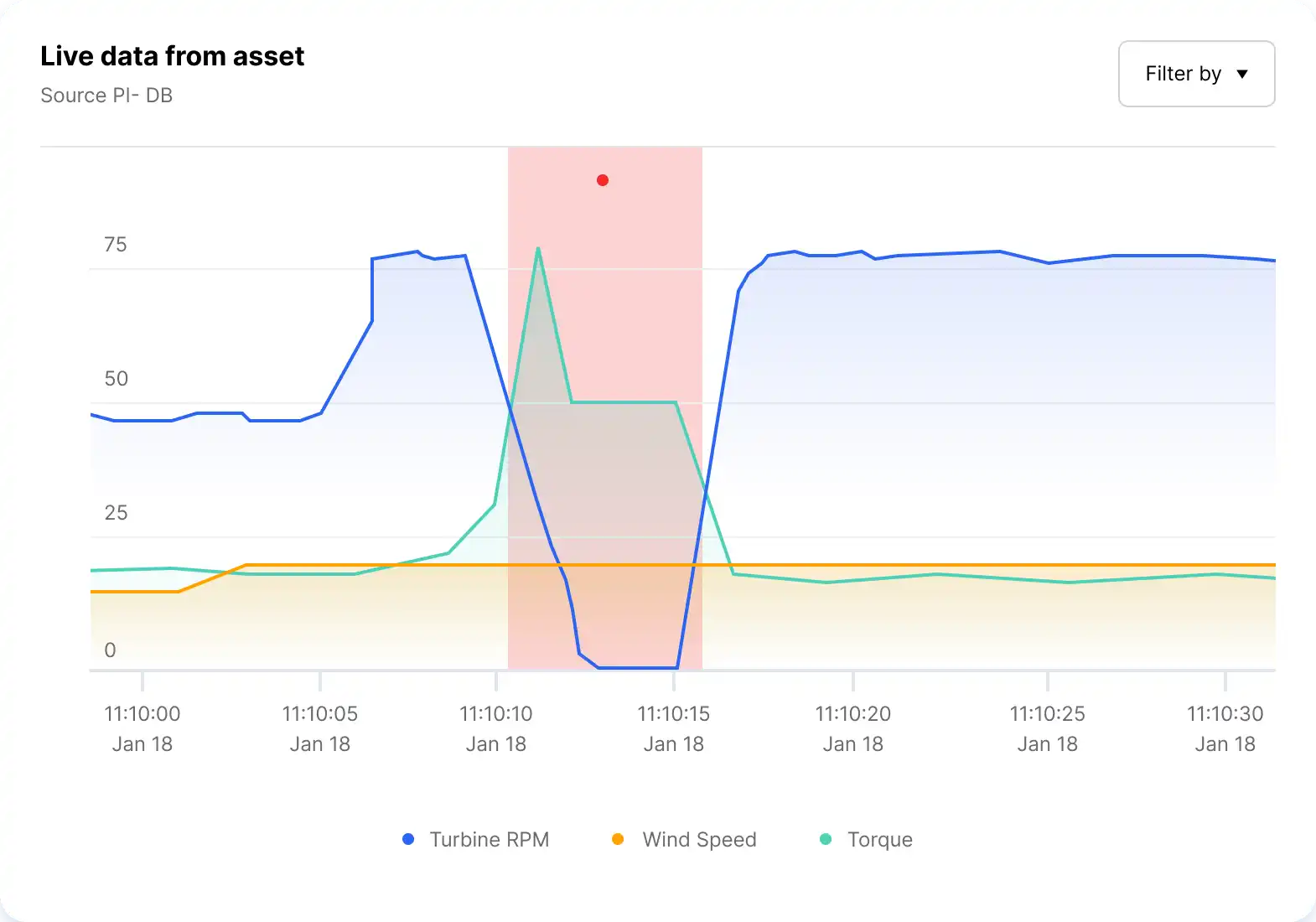
Unwanted behavior
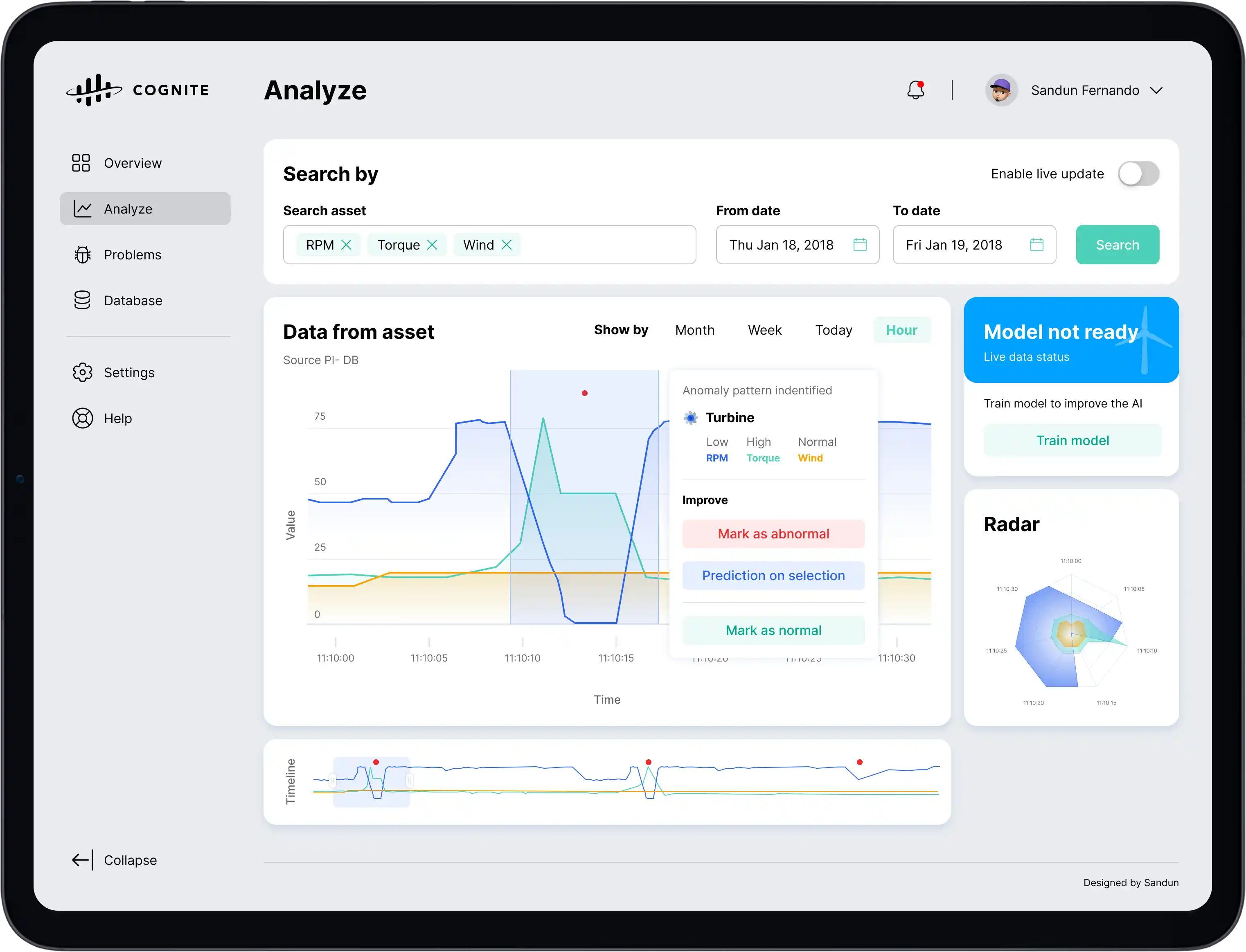
Anomaly: turbine speed drops suddenly while wind speed remains steady.
Result: a potential gearbox failure or efficiency loss developing unnoticed.
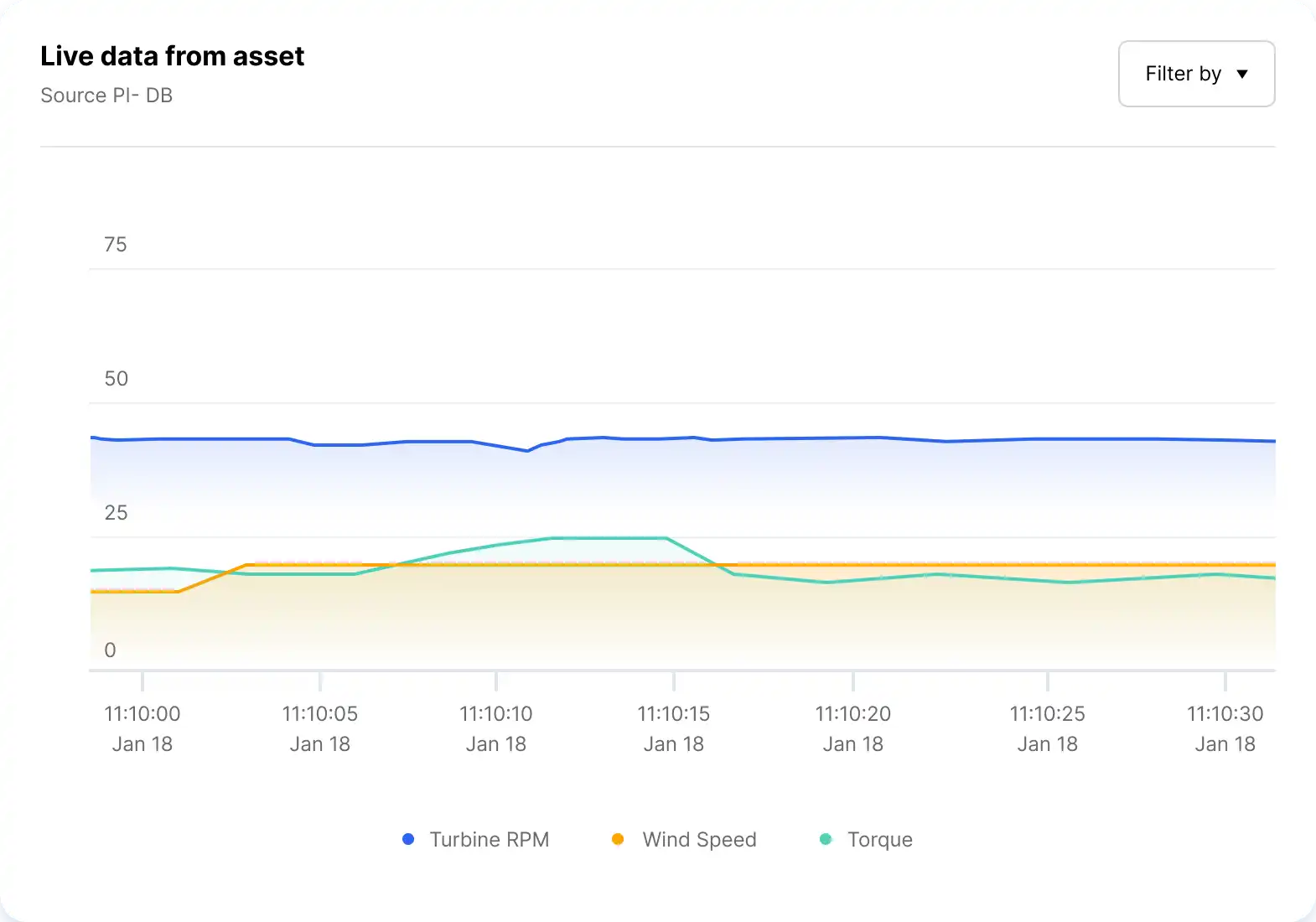
OK behavior
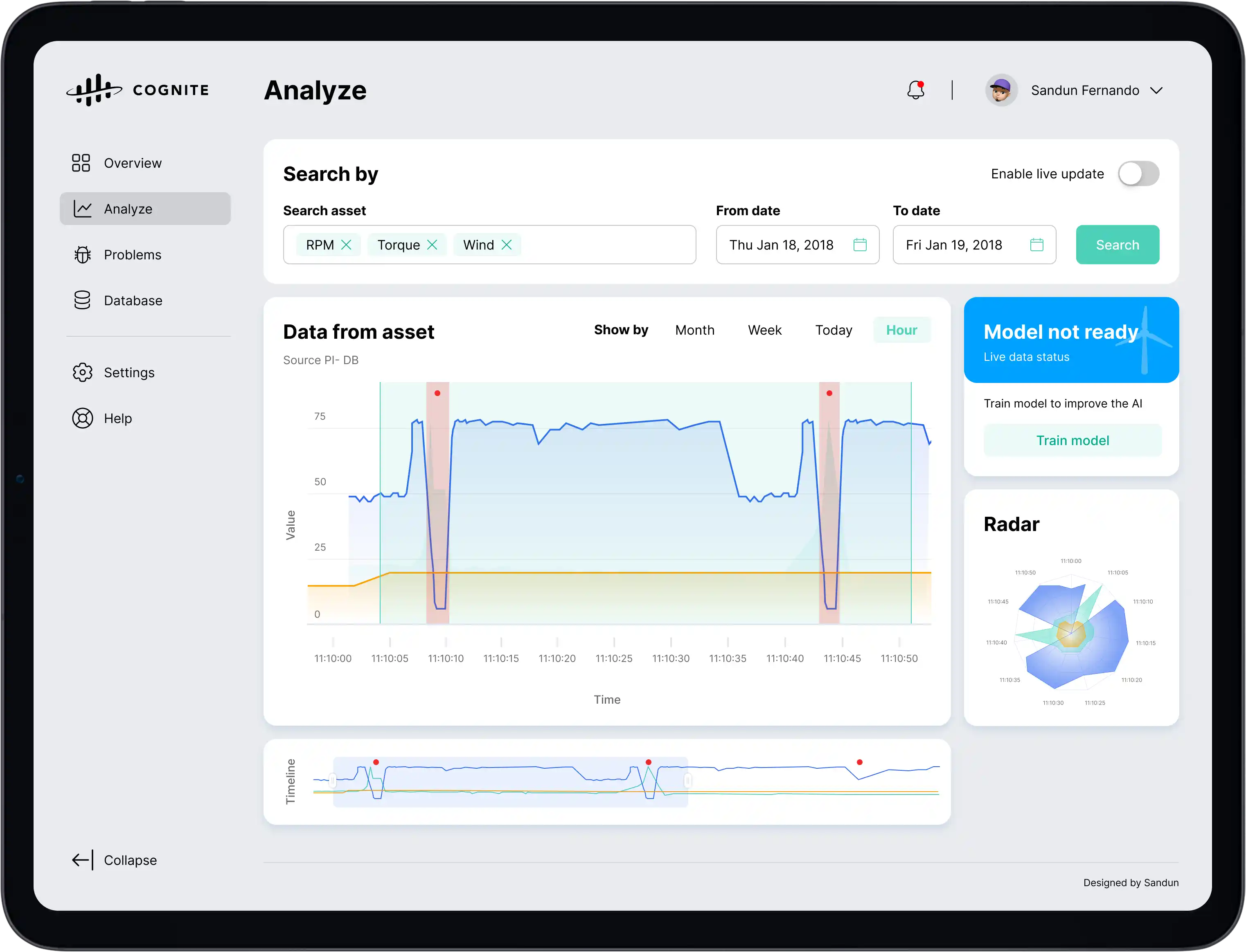
Normal operation: turbine speed drops, but it correlates with a drop in wind speed.
Result: the system behaving exactly as expected.
Two nearly identical-looking graphs. One signals a developing gearbox failure. The other is the turbine behaving exactly as expected. Legacy threshold alarms couldn't tell the difference, because they only ever watched one number at a time. The system we needed had to understand the relationship between RPM, wind speed and torque together, not each variable in isolation.
Turning a black box into a system engineers could verify
I led the end-to-end design of the anomaly detection experience, from the field research that uncovered why engineers didn't trust the existing alerts through to the interaction model that let them classify, verify, and progressively hand off routine corrections to the AI.
Field Research & Contextual Inquiry
Led 15 in-depth interviews and 60+ hours of on-site observation across 3 facilities to map how engineers actually investigated anomalies.
AI-to-UX Translation
Worked with data science to translate model confidence and classification logic into evidence engineers could read and check in seconds.
Human-in-the-Loop Workflow Design
Designed the classification, verification, and feedback loop that let engineers correct the AI and improve it over time.
Cross-Functional Facilitation
Ran heuristic evaluation and RICE prioritization workshops that aligned engineering, data science, and operations leadership around one roadmap.
Three compounding failures behind the mistrust
Silent failures hid behind simple thresholds
Legacy alarms only fired once a value crossed an extreme limit, missing the relationship between RPM and wind speed that actually signaled a developing failure, sometimes for weeks at a time.
An unexplained flag read as noise
The model caught real anomalies, but with no visible evidence behind a flag, engineers overrode 73% of the recommendations they didn't understand, discarding accuracy the AI already had.
Forty-seven hours a week, lost to searching
Engineers spent nearly a full extra work week every week searching for data, verifying alerts, and cross-referencing systems, time that should have gone to actually fixing turbines.
How might we give field engineers a system they trust as much as their own judgment, one that shows not just what it detected, but why, with evidence they can verify in seconds rather than hours?
If we replace opaque threshold alarms with a transparent, evidence-backed anomaly classification framework, and keep engineers in the loop through a continuous feedback cycle, then false positives will fall, trust in the system will grow, and engineers will act on flagged anomalies with confidence instead of skepticism.
Sixty hours in the field, not behind a desk
To find out why engineers didn't trust the existing anomaly alerts, I spent time observing real maintenance shifts across three facilities, rather than only asking about the problem after the fact.
Where engineer time actually went, per week
↑ Forty-seven hours of engineer time disappeared every week, more than a full extra work week, spent chasing data instead of fixing turbines.
Field Shadowing · 15 interviews, 3 facilities
Observed real alert investigations across day and night shifts, including offshore and remote personnel.
Survey Validation · n=120
Confirmed the shadowing findings held at scale across the broader engineering population, not just the sites I visited.
Heuristic Evaluation
Evaluated the legacy system against usability heuristics with engineering, surfacing two severity-one gaps: no visibility into AI confidence or data quality, and no warning before a threshold change took effect.
Remote Research · 8 sessions
Reached offshore and night-shift engineers that on-site visits alone would have missed, uncovering mobile-first usage patterns.
Key research insight
"We don't need more data. We're drowning in it. What we need is confidence that what the system is telling us is actually true. I need to understand why it's flagging something, see the evidence, and make the call myself."
Senior Maintenance Engineer, Offshore Energy Platform · 15 years experience
What sixty hours in the field made clear
An unexplained flag reads as noise, not a warning
Engineers overrode 73% of AI recommendations they couldn't verify, discarding accuracy the model already had simply because the reasoning behind it stayed hidden.
A data quality problem looks identical to a model problem
When results looked wrong, engineers assumed the AI itself was broken. The actual cause was frequently inconsistent sensor data upstream, not the detection logic downstream.
Engineers wanted a recommended action, not another dashboard
Field engineers preferred a specific recommended action over an open-ended data view by four to one. Confidence mattered less than knowing exactly what to do next.
Six rules we designed by, and why
1 · Proactive intelligence
Derived from reactive alerts arriving too late to prevent downtime.
→ Shifted detection to predict developing failures early, cutting emergency responses by 35%.
2 · Trust through verification
Derived from only 23% of engineers initially trusting automated detection.
→ Every flag ships with the specific sensor evidence behind it, not just a score.
3 · Human-in-the-loop design
Derived from models trained without engineer feedback plateauing in accuracy.
→ A classification and correction loop where every verification retrains the model, improving long-term accuracy by 68%.
4 · Progressive disclosure
Derived from engineers overwhelmed scanning raw, multi-system telemetry.
→ Led with a single recommended read, full sensor detail on demand, cutting decision time by 40%.
5 · Context over data
Derived from field engineers preferring a recommended action over a data dashboard by four to one.
→ Every anomaly view leads with "what to do," not just "what we measured."
6 · Explainable AI
Derived from 73% of engineers overriding recommendations they couldn't understand.
→ Every classification pairs with its reasoning path, evidence, and historical accuracy.
Three phases, from static thresholds to autonomous action
01 Phase 01 Threshold Alarms: the Starting Point
The legacy system's fixed-limit alarms only fired once a value crossed an extreme threshold. By then, developing failures like gearbox slippage had often gone unnoticed for weeks. Testing this approach against real incident logs confirmed thresholds alone would have missed most of the "silent" failures engineers described in interviews.
02 Phase 02 The Four-Quadrant Classification Framework
Working with data science, I defined anomaly states from the relationship between RPM, wind speed, and torque, rather than any single variable in isolation: normal operation, turbine issues, parts issues, and blade or system issues, each carrying its own priority and recommended response. Validating this framework against 10,000+ historical incidents reached 94% classification accuracy, with an average diagnosis time of 3.2 minutes.
03 Phase 03 From Human-in-the-Loop to Human-on-the-Loop
Once engineers trusted the classification framework's evidence, we introduced agentic automation for a narrow set of low-risk, pre-validated corrections, like adjusting blade pitch or torque load, executed in milliseconds. The engineer's role shifted from approving every action to reviewing and overriding exceptions, with full authority retained at all times.
The choices that shaped the outcome
Decision 01 · Full autonomy vs. human-on-the-loop oversight
Tension: Field engineers work in a safety-critical environment and were understandably wary of a system that could act on its own.
Choice & trade-off: We kept a visible, always-available emergency override and restricted autonomous action to a narrow set of pre-validated, low-risk corrections. Anything outside that boundary still routes to a human first.
Decision 02 · A confidence score alone vs. confidence plus evidence
Tension: A bare confidence percentage is faster to build, but engineers said a number alone told them nothing about whether to trust it.
Choice & trade-off: We paired every confidence score with the specific sensor evidence behind it. It took longer to design and build, but it was the single change that moved trust from 23% to the level needed for real adoption.
Decision 03 · A four-quadrant framework vs. a simple pass/fail flag
Tension: A binary flag is easier for engineers to scan, but it hides the difference between "check this eventually" and "respond now."
Choice & trade-off: We built the more complex four-way classification. Anomalies genuinely carry different urgencies, and collapsing that distinction would have recreated the same alert fatigue we set out to fix.
One system, evidence at every step
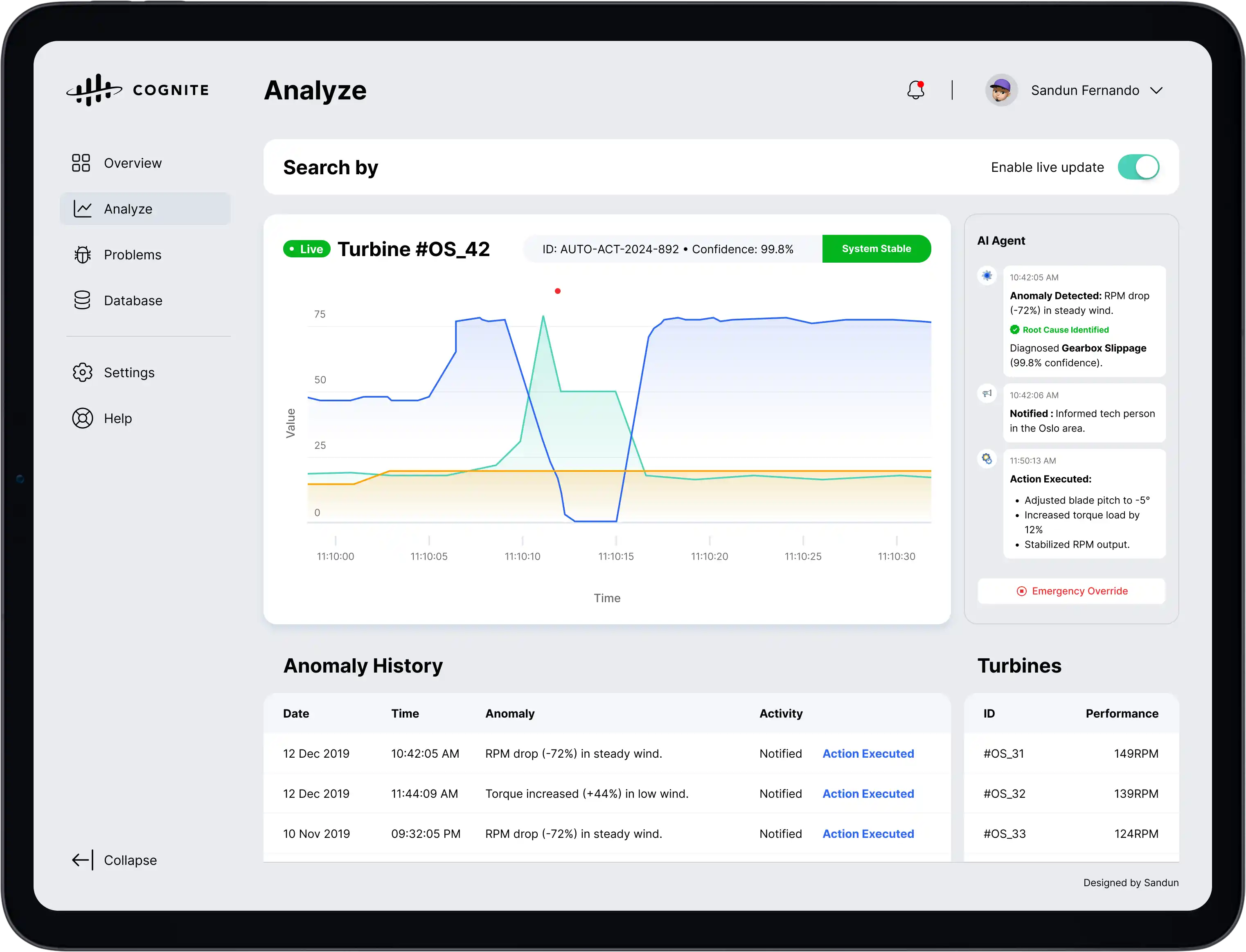
↑ Individual Turbine AI Analysis: predictive insight overlays the turbine's telemetry directly, showing the evidence behind every flag rather than a bare score.
Confidence & Evidence Trail
Every flag pairs a confidence score with the exact sensor readings that produced it.
Contextual Baselines
Historical comparisons show how a reading deviates from that turbine's own normal, not a generic benchmark.
One-Click Recommended Action
Every anomaly view leads with a ranked, actionable recommendation, not just the underlying numbers.
Direct action interface: maintenance teams schedule repairs, order parts, or trigger emergency protocols straight from the analysis view.
Post-training verification: shows how the model's precision improves after each round of engineer feedback, closing the loop visibly.
Design doesn't happen in isolation
Data science: keeping evidence honest
Close collaboration on model transparency ensured the confidence scores and evidence shown in the UI reflected what the model actually weighted, not a simplified story that happened to look convincing.
Field engineering leadership: defining override authority
Working sessions with facility leadership established the "Glass Box" collaboration model: the AI as a transparent watchdog flagging issues with evidence, the engineer as the judge who validates findings and always retains override authority.
Operations teams: validating findings on the ground
Eight remote research sessions with offshore and night-shift operations teams confirmed the classification framework held up during real, live alert investigations, not just in controlled walkthroughs.
How we arrived at the solution
Contextual Inquiry & Field Shadowing
Spent 60+ hours across 3 facilities and 15 interviews, replaying real alert investigations step by step alongside engineers.
Heuristic Evaluation & RICE Prioritization
Evaluated the legacy system against usability heuristics with engineering, then ran a RICE-scored workshop with data science and operations leadership to sequence features.
Illustration Placeholder
Prompt: A stylized illustration of a wind-farm operations control-room research session, engineers and a designer reviewing live turbine telemetry on a wall display, in industrial teal and emerald accent tones. Rendered as a clean illustration on a fully transparent background (no backdrop, scene, or color fill), so it displays cleanly on both light and dark page themes.
From alert fatigue to trusted, evidence-backed action
Detection accuracy reached 92% and user satisfaction climbed to 89%, up from 35% before the redesign. The program returned 4.2 times its investment within 18 weeks of launch.
Honest reflections from the process
What Worked
Data quality was the real foundation
Unifying full-stack data collection mattered more than any single UI decision. The AI, and the interface built on top of it, was only ever as trustworthy as the data feeding it.
Evidence beats explanation
Once engineers could see the specific evidence behind a flag, rather than just a confidence score, adoption followed almost immediately.
What I'd Do Differently
Introduce the human-on-the-loop model earlier
We spent months validating human-in-the-loop trust before proposing any autonomous action. Some of that validation could have run in parallel with early automation prototypes instead of strictly after.
Measure engineer confidence directly, not just accuracy
We tracked detection accuracy and time saved closely, but a direct, repeated trust survey would have caught early skepticism before it only surfaced anecdotally in interviews.